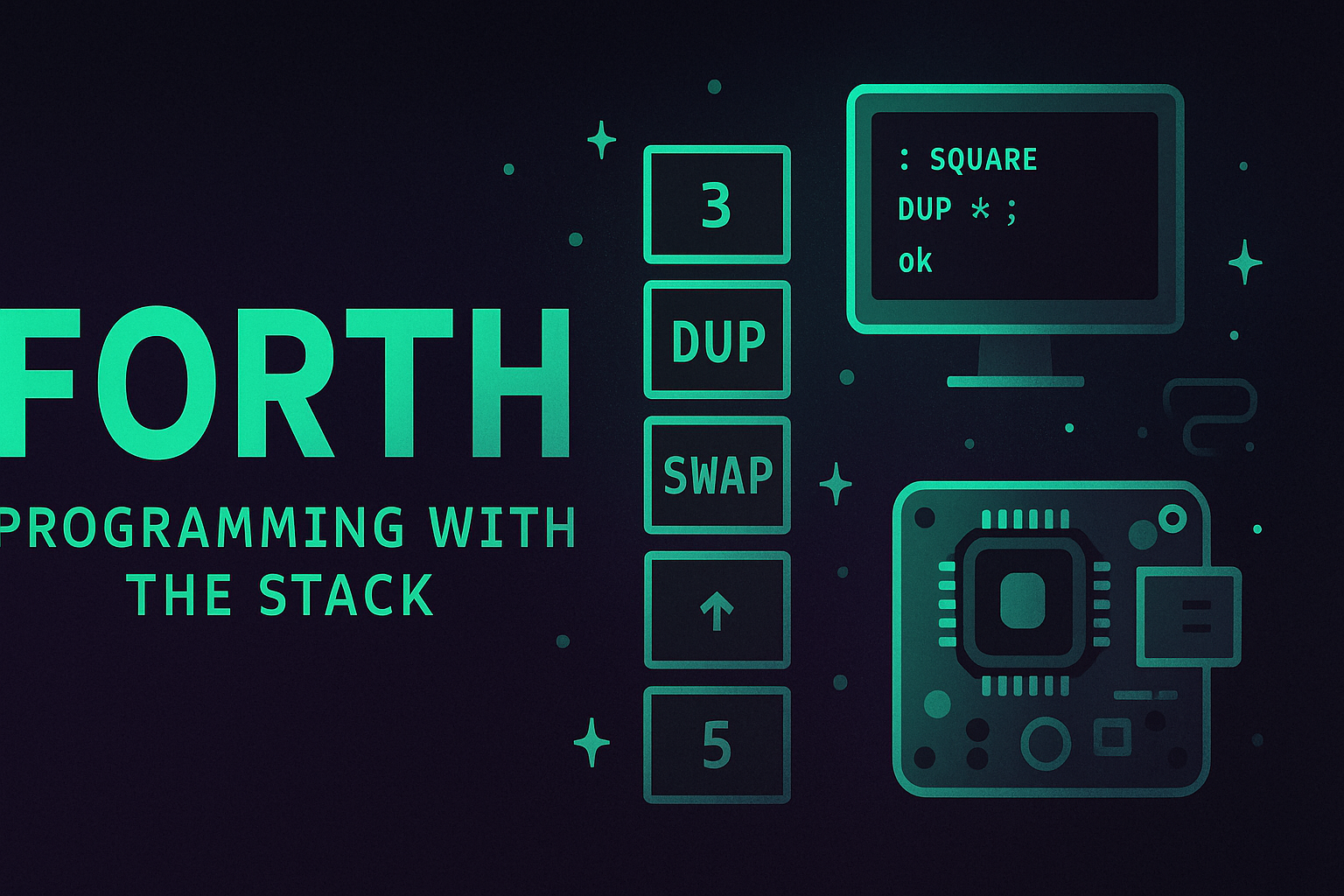
Forth — A Minimal Language with Maximum Power
en / languages / gforth — 2025-10-15 00:00:00
⚙️ Forth — A Minimal Language with Maximum Power
Forth is a compact, stack-based programming language designed in the late 1960s by Charles H. Moore.
It emphasizes simplicity, speed, and direct hardware interaction, making it a favorite in embedded systems, robotics, and environments where efficiency matters more than syntax.
Unlike most modern languages, Forth isn’t built around statements or functions — it revolves around words and a data stack. Every operation pushes or pops values from this stack, which makes the language extremely powerful but also challenging for newcomers.
Core Concepts
- Stack-based computation:
All operations manipulate values on a data stack. For example:
3 4 + .
pushes 3 and 4 onto the stack, adds them, and prints the result (7).
- Words:
In Forth, functions are called words. You can define your own easily:
- SQUARE ( n -- n² ) DUP * ;
This defines a new word
SQUAREthat duplicates the top of the stack and multiplies the two values.
-
Interactive interpreter:
Forth systems combine a compiler and interpreter in one. You can type commands interactively, making it feel like a live shell. -
Portability:
Forth systems can be extremely small — even fitting into microcontrollers with only a few kilobytes of memory.
Forth Philosophy
“Forth is not just a language — it’s a way of thinking.”
Forth encourages programmers to build their own abstractions, instead of relying on built-in ones.
This minimalism means the language doesn’t impose a programming style; instead, it gives you tools to define your own.
Because of this, Forth often acts as both a programming language and a custom environment for controlling hardware, testing prototypes, or scripting systems.
SwiftForth vs. Gforth — Modern Implementations Compared
| Feature | SwiftForth | Gforth |
|---|---|---|
| Developer | FORTH, Inc. | GNU Project |
| License | Proprietary (commercial) | Free software (GPL) |
| Platform | Windows, macOS, Linux | Linux, macOS, Windows |
| Performance | Highly optimized native code | Portable, slower but improving |
| Extensibility | Includes IDE, assembler, debugger | Extensible via C and POSIX libraries |
| GUI Integration | Built-in tools for desktop apps | None by default (terminal-based) |
| Target Audience | Industry and embedded engineers | Hobbyists, researchers, and educators |
| Documentation | Commercial-grade manuals and support | Community docs and examples |
| Cost | Paid license | Free and open-source |
⚡ Summary of Differences
-
SwiftForth is a commercial-grade implementation designed for professionals and companies who need performance, stability, and direct hardware control. It includes an IDE, native assembler, and debugging tools.
-
Gforth is the open-source GNU version of Forth — designed for education, experimentation, and research. It integrates well with Linux systems, supports dynamic linking with C libraries, and is ideal for learning or prototyping.
Practical Use Cases
| Use Case | SwiftForth | Gforth |
|---|---|---|
| Embedded systems | ✅ Highly optimized | ⚙️ Possible, with customization |
| Education & learning | ߒ᠕sable, but commercial | ✅ Perfect for students |
| Cross-platform scripting | ⚙️ Partial | ✅ Full |
| Performance-critical software | ✅ Excellent | ⚙️ Moderate |
Learning Forth Today
If you want to explore Forth without cost or setup complexity, start with Gforth:
```bash sudo apt install gforth gforth
- Then type:
- HELLO ." Hello, world!" ; HELLO
You’ve just defined your first Forth word!
For commercial work or embedded targets, SwiftForth offers a robust environment, built-in assembler, and IDE — ideal if you need to deliver production-ready firmware.
Wࠗhy Forth Still Matters
Despite being over 50 years old, Forth remains unique:
It forces you to think differently about how code and memory interact.
It’s incredibly portable — you can write a working interpreter in a few hundred lines of C.
And it runs on everything from microcontrollers to modern Linux desktops.
Forth embodies minimalism, control, and transparency — principles that still inspire new languages today, including parts of Lua, Factor, and even some Python metaprogramming ideas.
In Short
Forth is more than a language — it’s a toolbox for thinking in pure logic and control.
If you value efficiency, clarity, and hands-on computing, learning Forth (through Gforth or SwiftForth) will change the way you approach programming forever.
Resources
Gforth Official Page
SwiftForth by FORTH, Inc.
Wikipedia: Forth (Programming Language)